The readiness assessment that learns from your graduates.
RISE assesses your applicants before they enroll, then measures what happens after — learning what your successful students look like so you can enroll more who fit that profile, or develop incoming students to get there. Entrance exam, open enrollment, or both, program by program: RISE fits your model.
Book a walkthroughMore starts. Better starts.
A traditional entrance exam does one thing to your applicant pool: shrinks it. RISE grows it. Every applicant is matched against the profile of your successful students — the matches enroll with confidence, and the near-misses aren’t turned away, they’re trained toward the profile and become starts you would have lost.
Open enrollment? Same engine, different door. Every incoming student is matched against that profile, and the gaps get intervention before they become withdrawals.
Then the 30-, 60-, and 90-day success rates show, program by program, whether those students are holding. More starts, better prepared, fewer withdrawals — term after term.
Built for Your Market
Developed on research into the skills graduates of career colleges, trade schools, and community colleges actually use on the job — not abstract college readiness.
See Your First Term Clearly
30-, 60-, and 90-day success rates by campus and program, starting with your first cohorts. The picture sharpens as the numbers grow — early signals now, while your graduation data builds toward the profile of your successful students.
$5. Everything. No Contract.
Every applicant, every layer, every retake — one price, billed only on use. No tiers, no setup fees, no annual contract.
Your enrollment model. Your call.
One assessment — you decide what the score does.
Entrance Exam
Screen applicants against the profile of your successful graduates — and turn near-misses into enrollments instead of rejections.
Learn more →Open Enrollment
Your students arrive with a wide range of skills. Learn what your successful students look like, then close the gaps with targeted intervention.
Learn more →Hybrid
Entrance exam for some programs, open enrollment for others, conditional enrollment in between — one assessment, configured by program.
Learn more →At its core, a cognitive assessment — built for career-focused students.
RISE is a configurable readiness assessment built for career-focused education. At its core, it's a set of cognitive questions designed specifically for students in career colleges, trade schools, and community colleges — measuring the skills their programs actually demand. From there, you add only the layers your school needs.
What RISE measures
- Reading comprehension
- Quantitative reasoning
- Information literacy
- Procedural reasoning
RISE comes in two versions — RISE Core, the standard assessment, and RISE Fundamentals — both measuring the same four areas, at the same price. We'll help you match versions to your programs.
How RISE gets better at your school.
Most assessments hand you a score and walk away. RISE closes the loop.
You assess your applicants. At the end of the term, you tell us who's still enrolled, who left, and who finished — a spreadsheet you're already producing for your accreditor, or a direct connection to your SIS.
That's when RISE stops being a test and starts being your test.
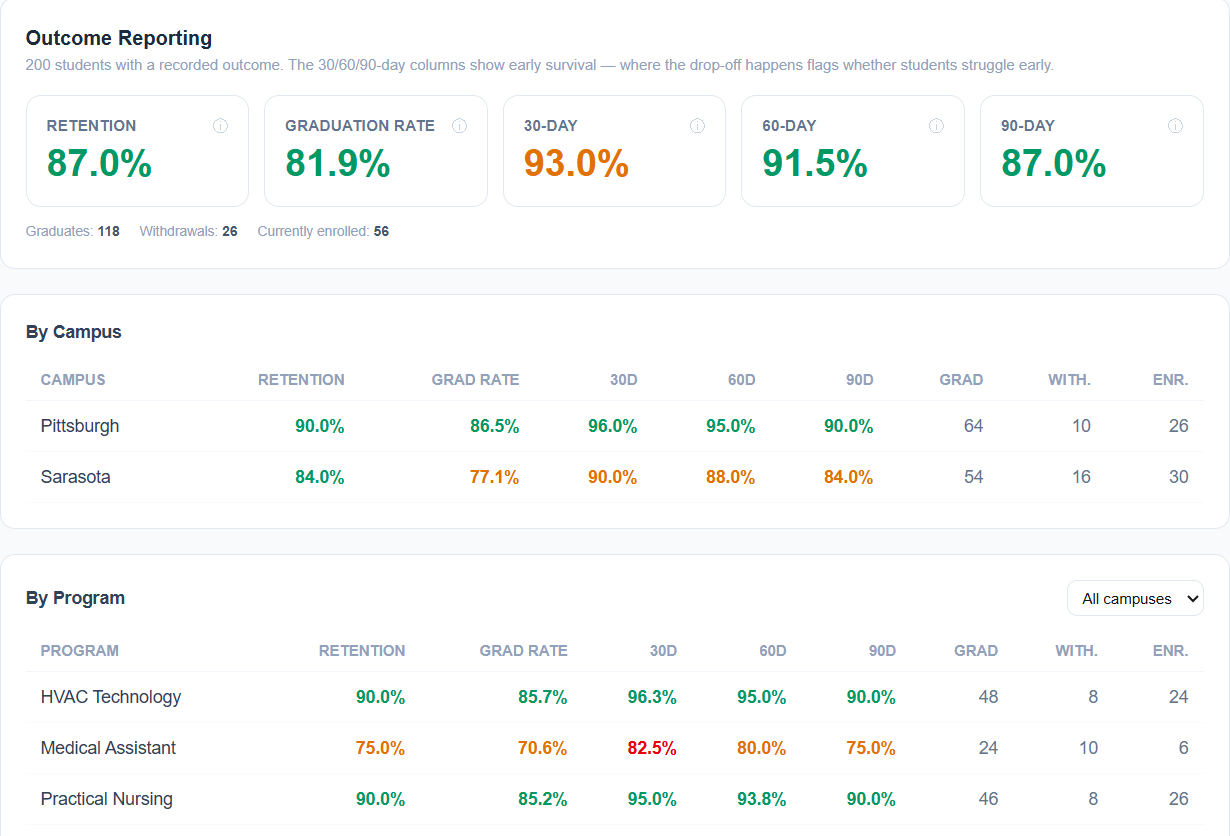
Your dashboard shows what actually happened — 30, 60, and 90-day success, retention, graduation — broken out by campus and by program. Where students are falling away, and where they aren't.
Medical Assistant is losing students in the first 30 days. HVAC isn’t. Now you know where the work starts.
Measuring is the easy part.
Any school can correlate test scores against completion. Run the numbers on a fixed, off-the-shelf assessment and you may well learn that it doesn't predict much about your programs — and then you're holding an expensive confirmation of a problem you can't fix. The test came in a box. The only move left is to slide the cutoff up or down and hope.
RISE is different because we built the questions. When the data tells us something, we can act on it.
What acting looks like
Reweighting
Once graduation data is in, we look for the questions that actually separated finishers from non-finishers in your programs — and shift the weight toward them. The total stays the same. Your passing line doesn't move, and last year's cohort is still comparable to this year's. The scale is identical; the instrument is more accurate.
Training, targeted
If withdrawals share a specific weakness, we can route applicants into focused modules on exactly that, before they enroll.
Program-level bars
Programs differ. If one is losing students at 30 days who cleared the bar comfortably, the bar may be in the wrong place for that program.
New questions
Sometimes the answer isn't new weights — it's that something your programs demand isn't being measured yet. When that happens, we write and validate the questions, and they go through the same test as everything else.
Every one of these points at the same target: does the assessment tell you who succeeds at your school. Nothing else.
A team, not a dashboard.
Every school's data tells a different story, and none of this is automatic. We read your results with you and tell you what we think they mean — and we only recalibrate when the data can actually support it. A recommendation we can't defend isn't worth making.
You'll see something after your first term.
RISE doesn't need years of data to be useful. It needs one term.
Term one
what happened
Report your outcomes and the picture arrives immediately: 30 and 60-day success, retention, broken out by campus and program. This is the term where you find out where students are actually falling away. Not why yet — where.
Term two
what's holding
90-day success enters the picture. Retention becomes a trend instead of a snapshot. The patterns you couldn't be sure of after one term either hold up or don't.
As graduates accumulate
what predicts
Completion data is the one worth waiting for. It's what lets us look at your questions and find the ones that separated finishers from everyone else. That's the first calibration, and it's when the assessment stops being a national instrument and starts being yours.
We'd rather tell you that than imply the assessment arrives already tuned to your programs. It doesn't. No assessment does — the difference is that ours changes.
Add only what your school needs.
The cognitive assessment stands on its own. Each of these layers is fully optional — turn on the ones that fit, all covered by the same $5.
Persistence & Readiness
OptionalThe cognitive assessment tells you whether an applicant can do the work. Persistence & Readiness tells you whether they're likely to finish it — the part a skills score alone can't see. The applicant who can do the work but won't finish it is the most expensive student you'll enroll this year.
Persistence
Demonstrated drive and follow-through. It draws on how applicants have actually handled effort, setbacks, and commitments — not on how they rate themselves. Because it's behavioral rather than self-flattering, it's much harder to game.
Readiness
How prepared the applicant is to step into the program itself — their grasp of what it takes to succeed as a student, study habits, and academic mindset. A measured part of the score: preparedness for the work ahead, not outside circumstances.
Two applicants with the same cognitive score can have very different odds of finishing. This layer surfaces that difference before enrollment — so you can admit with confidence, or put support in place exactly where it's needed.
Training
OptionalMost assessments stop at a score. Training turns the gaps it finds into a path forward.
When RISE identifies where a student needs to strengthen, you choose how to close the gap. Use your own intervention training and support services — the assessment tells you exactly where to point them. Or turn on RISE's built-in training: focused modules targeted to the exact areas the results flagged — not a generic course, but the specific skills that student needs.
It fits every model. Entrance exam schools can route near-miss applicants through training before they enroll — and treat completion as the signal it is, or retest afterward. Open enrollment schools can offer it before enrollment or build it into a student's first term — whichever fits the intervention plan their profile calls for.
Either way, completing training does two things at once. It closes the skill gap — and the effort itself becomes a signal: a student who works through the modules is showing the willingness to learn and the persistence to follow through.
Online Readiness (ORA)
A separate assessment that gauges whether an applicant is set up to succeed in an online or hybrid program — the self-direction, habits, and environment online learning demands.
Pre-assessment questions
Short, unscored questions that surface outside-the-classroom pressures — financial strain, work schedules, childcare, and the like — so you can spot practical barriers early. They inform your decision; they don't affect the score.
Custom questions
Add your own — for the Support Check-In or anywhere else you want to hear from applicants directly. Like pre-assessment questions, they're unscored and don't affect results. The scored assessment stays research-based, because it's the thing we validate against your outcomes.
That $5, in full.
Everything included
The $5 covers either RISE Core or RISE Fundamentals, every optional layer you add — persistence & readiness, training, online readiness, pre-assessment, and custom questions — plus all retakes. The outcome dashboard and recalibration come with it.
Pay only for what you use
Billed monthly, based on usage — you're charged only for the applicants you assess. No setup fees, no upfront license, no annual contract.
RISE vs. a traditional admissions test.
Traditional tests are fine at what they do. They just never close the loop.
Traditional —Four-year college readiness.
RISE —The skills career-focused graduates use on the job.
Traditional —Hands you a score and walks away.
RISE —Measures your outcomes and recalibrates.
Traditional —The same test at every school.
RISE —Learns your school — becomes a profile of your successful graduates.
Traditional —A rejection.
RISE —A path forward, with targeted training before they enroll.
Traditional —Entrance exam only.
RISE —Entrance exam, open enrollment, or both — configurable by program.
Traditional —Per-test fees, setup costs, contracts.
RISE —$5 per applicant, everything included, no annual contract.
Traditional —Contracts and setup costs you've already sunk.
RISE —No contract — stop whenever it stops earning its keep.
What you'll see in the walkthrough
A short look at RISE, your questions answered, and whether it fits your programs.
RISE in action — the assessment and the results an advisor sees.
The outcome dashboard — your scores against retention, early success, and graduation.
Which assessment fits your programs — Core or Fundamentals.
Reporting your outcomes — exactly what we need from you, and how you'd send it.
How to get started — at your pace, no commitment.
See what RISE can do for your school.
A short, no-pressure walkthrough — the Cal.com scheduler will live here on the production page.
Book a walkthrough